

Anger is one of the emotions people notice most quickly, both in themselves and in others. It can show up as frustration, irritability, shutting down, criticism, impatience, defensiveness, or explosive reactions. Sometimes it feels like anger arrives out of nowhere. Other times, it becomes such a familiar pattern that it simply feels like part of who we are.
But what if anger is not actually the whole story?
In Emotionally Focused Therapy (EFT), we often understand anger as a secondary emotion… an emotion that appears on the surface while something more vulnerable lives underneath.
Anger Often Covers More Tender Feelings
Imagine emotions like an iceberg.
Above the surface—the part everyone sees—might be:
- Irritability
- Frustration
- Defensiveness
- Criticism
- Withdrawal or shutting down
- Anger
But underneath the surface, there is often something much more vulnerable happening:
- Hurt
- Fear
- Shame
- Sadness
- Loneliness
- Feeling unseen or unimportant
- Feeling inadequate or not “good enough”
- Fear of failure
- Fear of rejection or losing someone we love
- Grief
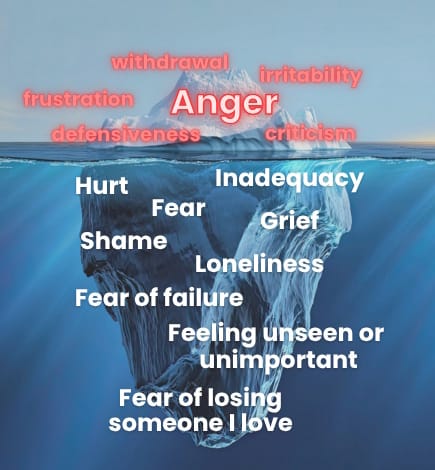
Often, anger is not the core emotion. It is the protective layer that helps us manage feelings that are harder to tolerate or express.
For example:
- Someone who becomes angry after criticism may actually feel deeply inadequate underneath.
- A partner who reacts with irritation when feeling disconnected may actually feel lonely, hurt, or afraid the relationship is slipping away.
- A parent who seems impatient or reactive may be carrying exhaustion, worry, or fear of failing the people they love.
The anger is real, but it is often protecting something more tender.
Why Vulnerable Feelings Get Hidden
Many people grow up learning, directly or indirectly, that some emotions are safer than others. Maybe emotions were dismissed growing up. Maybe vulnerability felt dangerous. Maybe expressing hurt led to rejection, criticism, or being misunderstood.
Over time, we adapt.
Instead of feeling sadness, we feel irritation. Instead of fear, we feel frustration. Instead of saying, “I feel hurt” or “I’m afraid I’m not enough,” anger becomes the quickest and most accessible emotional pathway.
For some people, vulnerable emotions become so buried that anger feels like the only emotion left available.
Not because vulnerability is absent, but because it has been hidden for a very long time.
What EFT Does Differently
In Emotionally Focused Therapy, we don’t simply try to “get rid of anger.” Instead, we get curious about it.
We slow things down and ask questions like:
- What happened right before the anger showed up?
- What feeling flashed through, even for a moment, underneath the reaction?
- What feels threatened here?
- What matters so deeply that this response is showing up?
Often, when we slow the process down enough, we discover that anger is carrying an important message. As the deeper emotions become clearer, something important begins to happen: the emotional reaction starts to make sense.
And when something makes sense, it becomes easier to respond differently.
The Goal Is Not Less Emotion—It’s More Understanding
Many people come to therapy wanting to stop feeling angry. But often, healing begins not by pushing anger away, but by understanding what it has been protecting.
Anger is not bad. It is often trying to protect us.
The question is whether it is helping us communicate what we truly need—or keeping us disconnected from ourselves and the people we care about.
Sometimes the path forward begins with a simple question:
What might my anger be trying to protect?